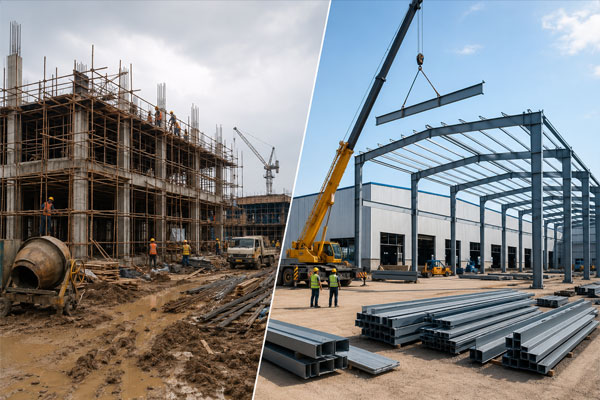
Traditional Construction Problems vs PEB Solutions
Industrial construction needs proper planning, strong structure, and fast project completion. But in traditional construction, many factory owners and warehouse owners face problems like project delays, high labour cost, material wastage, and future expansion issues.
A Pre-Engineered Building, also called PEB, is a smart solution for modern industrial construction. It uses pre-designed and factory-made steel components that are assembled at the site. This makes construction faster, cleaner, and more cost-effective.
PEB structures are useful for warehouses, factories, industrial sheds, cold storage, logistics hubs, commercial buildings, and large-span industrial projects.
What is a Pre-Engineered Building?
A Pre-Engineered Building is a steel building system made with pre-fabricated components. These parts are designed and manufactured in a factory and then transported to the site for installation.
Main parts of PEB include:
- Columns
- Rafters
- Purlins
- Girts
- Roof cladding
- Wall cladding
- Eave struts
- Bracing system
PEB is widely used because it saves time, reduces construction problems, and gives strong building performance.
Problem 1: Slow Construction Time
Traditional construction often takes more time because many activities are done at the site. Labour work, material handling, curing time, and weather delays can slow down the project.
How PEB Solves This Problem
PEB components are manufactured in a factory and assembled quickly at the site. This reduces site work and helps complete projects faster.
Benefits:
- Faster project execution
- Quick installation
- Less site dependency
- Better planning
- Faster business start
Problem 2: High Labour Cost
Traditional construction needs more labour for masonry, concrete, shuttering, finishing, and site work. This increases total project cost.
How PEB Solves This Problem
PEB needs less on-site labour because most components are factory-made. The site team mainly handles erection and fitting.
Benefits:
- Reduced labour cost
- Less manual work
- Faster installation
- Better cost control
- Lower project delay risk
Problem 3: Material Wastage
In traditional construction, material wastage can happen due to cutting, mixing, poor storage, and site handling.
How PEB Solves This Problem
PEB components are made with accurate design and measurements. This reduces wastage and improves material use.
Benefits:
- Less material wastage
- Factory-finished components
- Better accuracy
- Cleaner site work
- Cost-effective construction
Problem 4: Difficult Future Expansion
Many traditional buildings are difficult to expand later. If business grows, owners may need major changes or extra construction work.
How PEB Solves This Problem
PEB structures are flexible and can be planned for future expansion. This is useful for factories, warehouses, logistics hubs, and industrial sheds.
Benefits:
- Easy expansion
- Flexible design
- Scalable structure
- Suitable for growing businesses
- Better long-term planning
Problem 5: High Maintenance
Traditional buildings may need regular repair due to cracks, leakage, weather damage, and wall issues.
How PEB Solves This Problem
PEB structures are made with durable steel components and quality cladding. They are designed for long-term industrial use with low maintenance.
Benefits:
- Low maintenance
- Durable structure
- Better weather resistance
- Long service life
- Suitable for industrial conditions
Problem 6: Limited Large-Span Space
Traditional construction may need more columns inside the building. This can reduce usable space in factories and warehouses.
How PEB Solves This Problem
PEB can provide large-span building design with better open space. This helps improve material movement and machine layout.
Benefits:
- More usable space
- Better warehouse layout
- Easy machine installation
- Smooth vehicle movement
- Better storage planning
Problem 7: Poor Cost Control
In traditional construction, final cost may increase because of labour delay, material price changes, wastage, and extra work.
How PEB Solves This Problem
PEB offers better cost control because the structure is planned, designed, and fabricated before installation.
Benefits:
- Better budget planning
- Lower wastage
- Reduced labour dependency
- Faster completion
- Cost-effective project execution
Traditional Construction vs PEB
| Point | Traditional Construction | Pre-Engineered Building |
|---|---|---|
| Construction Time | Takes more time | Faster installation |
| Labour Requirement | More labour needed | Less site labour |
| Material Wastage | Higher wastage possible | Better material control |
| Expansion | Difficult and costly | Easier future expansion |
| Maintenance | More maintenance may be needed | Low maintenance |
| Space Use | More internal columns possible | Better large-span space |
| Project Cost | Can increase during work | Better cost control |
Where PEB Buildings Are Used
Pre-Engineered Buildings are suitable for many industrial and commercial applications.
| Application | Use |
|---|---|
| Warehouses | Storage and distribution |
| Factories | Manufacturing and production |
| Industrial Sheds | Machine and material handling |
| Cold Storage | Temperature-controlled buildings |
| Logistics Hubs | Fast goods movement |
| Commercial Complexes | Business and retail spaces |
| Agricultural Buildings | Farm storage and processing |
| Aircraft Hangars | Large-span storage space |
Benefits of Pre-Engineered Buildings
PEB gives many benefits for modern industrial construction.
- Faster construction
- Cost-effective solution
- Flexible design
- Low maintenance
- Strong steel structure
- Better space utilization
- Suitable for future expansion
- Less material wastage
- Durable for industrial use
- Good for large-span buildings
Why Choose NDC Engineering?
NDC Engineering provides Pre-Engineered Building solutions for industrial and commercial projects. The company offers design, fabrication, and installation support for PEB structures.
Key reasons to choose NDC Engineering:
- PEB structure manufacturer in Ahmedabad
- Steel building solutions for industries
- Suitable for warehouses and factories
- Faster project execution
- Flexible building design
- Durable and low-maintenance structures
- Support for industrial sheds and commercial buildings
- Strong focus on quality and structural safety
If you are planning an industrial building, warehouse, factory shed, or logistics space, NDC Engineering can help with a suitable PEB solution.
Conclusion
Traditional industrial construction can create many problems like slow project work, high labour cost, material wastage, difficult expansion, and high maintenance. These problems can affect business planning and increase project cost.
Pre-Engineered Buildings solve many of these problems with faster installation, factory-made components, flexible design, better space use, and low maintenance.
For businesses looking for a strong and cost-effective industrial building solution, PEB is a smart choice.
FAQs
A Pre-Engineered Building is a steel building made with factory-manufactured components that are assembled at the site.
PEB is faster because most parts are pre-made in the factory and only need assembly at the site.
PEB structures are used in warehouses, factories, industrial sheds, logistics hubs, cold storage, commercial complexes, and agricultural buildings.
Yes, PEB structures can be designed with future expansion needs in mind.
Yes, PEB can reduce labour cost, material wastage, and project delay, making it a cost-effective option.
NDC Engineering provides Pre-Engineered Building solutions in Ahmedabad, Gujarat, India.
Call to Action
Looking for a reliable Pre-Engineered Building solution for your factory, warehouse, or industrial shed? Contact NDC Engineering for durable and cost-effective PEB structures in Ahmedabad, Gujarat, India.